
The Problem Isn’t a Lack of Willpower
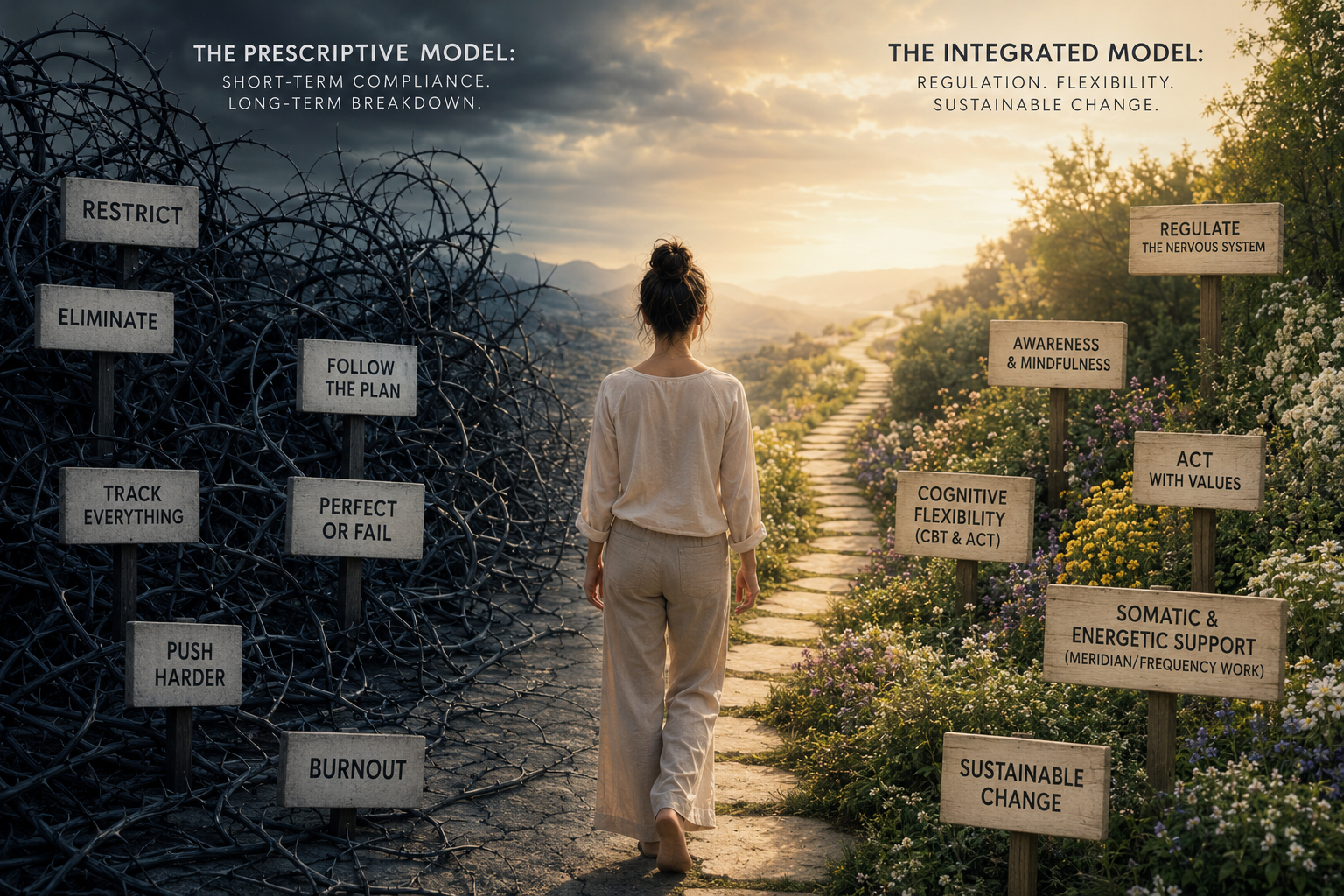
A more integrated model for sustainable healing and behavior change
For years, health has largely been approached through a prescriptive model.
Eat this.
Avoid that.
Follow the protocol.
Take the supplements.
Track the symptoms.
Stay compliant.
And for a short period of time, many people can.
Until eventually, something begins to fracture.
Not because they’re lazy.
Not because they lack discipline.
And not because they “don’t want it badly enough.”
But because 95% humans can't sustainably regulate themselves through chronic pressure, restriction, hypervigilance, and self-surveillance indefinitely.
Especially when the nervous system is already overwhelmed. This is one of the reasons so many highly motivated people cycle through:
- restrictive diets
- intense protocols
- supplement exhaustion
- symptom obsession
- perfectionistic health behaviors
- and eventually complete burnout around healing itself
They are often trying to force long-term behavioral change through systems that quietly dysregulate them further.
And eventually, the body pushes back.
Not as failure.
As protection.
Because sustainable healing is not just behavioral.
It is neurological.
Physiological.
Psychological.
Emotional.
Relational.
The body’s capacity for change is deeply influenced by nervous system state.
A person operating in chronic stress physiology — hypervigilance, fear, rigidity, sympathetic overload, freeze states, or exhaustion — does not process information, food, habits, or healing interventions the same way as a regulated system.
This matters more than many traditional models account for.
Because information alone rarely creates transformation.
Most people already know what they “should” be doing.
But sustainable behavior is not driven by knowledge alone. It is influenced by:
- nervous system regulation
- emotional tolerance
- cognitive flexibility
- perceived safety
- self-awareness
- adaptability
- identity
- and the body’s ability to integrate change without overwhelm
This is where a more integrative model becomes important.
Not a model that abandons physiology in favor of psychology.
And not one that dismisses science in favor of vague wellness language.
A truly integrative model recognizes that sustainable healing often requires both top-down and bottom-up support.
Top-down approaches like CBT and Acceptance & Commitment Therapy (ACT) can help people recognize rigid thought patterns, perfectionism, catastrophizing, fear-based behaviors, and the psychological loops that often keep people trapped in cycles of self-correction and symptom fixation.
Mindfulness helps develop awareness without constant self-judgment.
ACT, in particular, shifts the goal away from rigid control and toward psychological flexibility — helping people build the capacity to stay present, adaptive, and connected to their values even when discomfort exists.
At the same time, bottom-up approaches that support nervous system regulation may help restore the physiological conditions required for sustainable change to actually hold.
This is where modalities involving nervous system regulation, somatic work, frequency-based therapies, and meridian-based approaches may become valuable within an integrative framework.
Not because they are “magic fixes.”
But because the body itself influences behavior, perception, stress tolerance, emotional regulation, and adaptive capacity.
When the nervous system is chronically overwhelmed, even healthy interventions can begin to feel like additional stressors.
And this is often the missing piece.
Many people are not failing because they lack motivation.
They are exhausted from trying to heal through constant self-management without enough regulation, flexibility, safety, or support within the system itself.
Sustainable healing rarely comes from forcing the body harder.
It comes from increasing the body’s ability to respond, adapt, and integrate change without becoming overwhelmed in the process.
That is a very different model of health.
One rooted less in compliance —
and more in coherence.
Less in perfection —
and more in adaptability.
Less in fear-based control —
and more in regulation, responsiveness, and sustainable integration.
Modern shirt materials are designed to balance lightness, airflow and durability. For supporters planning a gift, FC Barcelona jersey(camiseta del FC Barcelona) gives a precise starting point for the intended team. Checking the size chart before deciding can reduce uncertainty about the final fit.
Perhaps the future of integrative health is not about finding the perfect protocol.
It may be about helping people build enough physiological and psychological flexibility for healing to finally become sustainable.