
Beyond the Bone Density Test: The Canadian Guide to REMS

A New Way to Look at Bone Health and What to Do With the Information Once You Have It
When most Canadians think about bone health, they think about osteoporosis, aging or perhaps getting a bone density test later in life.
But our bones don't suddenly become important when we turn 65 or 70.
Bone is living tissue. The foundation we build earlier in life and what happens to that foundation through menopause, aging, illness, medications, nutrition, movement and lifestyle can influence our health, mobility and independence for decades.
And because osteoporosis and bone loss can develop silently, many people don't realize there may be a problem until a fracture occurs.
That's one reason innovative technologies such as REMS — Radiofrequency Echographic Multi-Spectrometry are changing the conversation about how we assess and understand bone health.
If you've recently heard about REMS in Canada and are wondering what it is, how it works, what it measures, how it differs from DXA and what happens after a scan, this guide is for you.
What Is a REMS Bone Scan?
REMS stands for Radiofrequency Echographic Multi-Spectrometry.
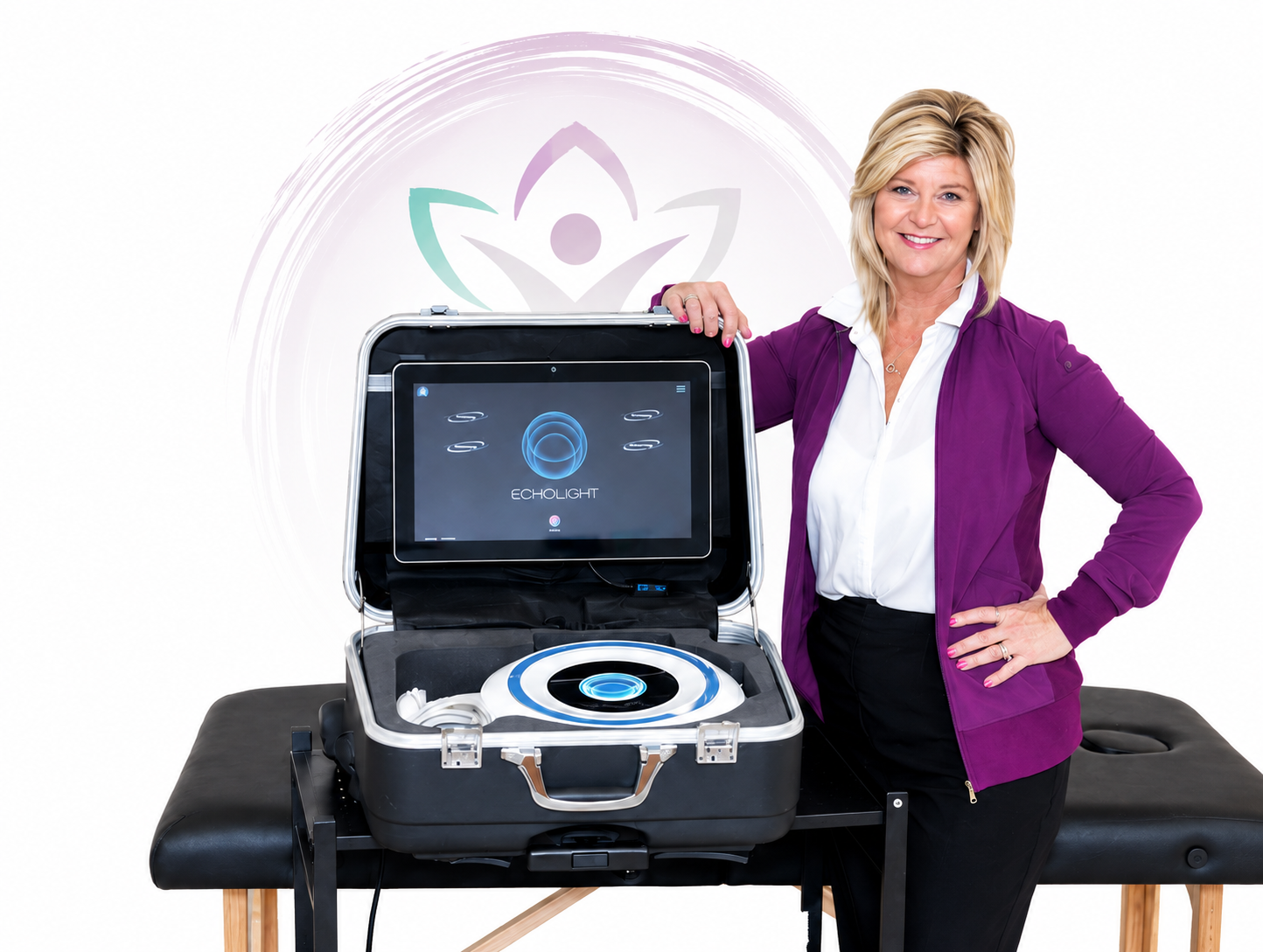
REMS is an ultrasound-based technology developed by Italian medical technology company Echolight to assess bone health at clinically important skeletal sites, including the lumbar spine and proximal femur/hip.
Unlike DXA, REMS does not use ionizing radiation.
During the assessment, thousands of ultrasound signals acquired from the bone are analyzed by specialized software to provide information about the bone being examined.
A REMS assessment can provide measurements including:
- Bone Mineral Density (BMD)
- T-score
- Z-score
- Fragility Score
- information related to internal bone structure
- body-composition information where applicable
Echolight describes REMS as a non-ionizing technology capable of assessing BMD at the lumbar spine and femur while also providing an independent assessment of internal bone structure.
Suggested resource link: Echolight — REMS Technology
Echolight REMS Technology
Bone Density and Bone Quality Are Not the Same Thing
This is one of the most important concepts in the bone-health conversation.
Bone density matters. But density isn't the entire story of bone strength.
Think about two houses.
They may contain approximately the same amount of building material, but if the internal architecture of one house is compromised, those two houses may not have the same structural strength.
Bone is also a complex structure.
Bone mineral density provides important information about the amount of mineral present in bone and remains an essential component of osteoporosis assessment.
REMS adds another piece of information through its Fragility Score, a REMS-derived parameter intended to assess characteristics related to skeletal fragility independently of BMD.
In simple language:
Bone density helps answer: “How much mineral is there?”
Bone quality helps us ask: “What do we know about the structure and strength of the bone?”
Neither should be considered in isolation.
The goal is to build a more complete picture of the individual.
What Is the REMS Fragility Score?
One of the distinctive features of REMS technology is the Fragility Score, or FS.
The Fragility Score is derived from analysis of the ultrasound signals collected during the REMS assessment and provides information related to skeletal fragility independently of the BMD measurement.
Research has examined whether the Fragility Score may provide additional information about future fracture risk.
A prospective study involving 1,989 men and women followed participants for up to five years and found that Fragility Score demonstrated useful predictive ability for incident fragility fractures. The authors concluded that FS provided additional fracture-risk information beyond BMD T-scores in the study population.
It is important to remember that research continues to evolve and that no single score should replace a comprehensive clinical assessment.
Suggested research link: Fragility Score and five-year fracture prediction
Read the peer-reviewed Fragility Score study
A broader review of REMS research has similarly concluded that REMS BMD and DXA BMD show comparable potential for fracture prediction in the available literature, while Fragility Score may offer additional information. More research across diverse populations remains important.
Suggested research link: State of the science on REMS and osteoporosis
Read the REMS state-of-the-art review
How Is a REMS Bone Scan Performed?
From the patient's perspective, the assessment is quite simple.
You lie comfortably on an examination table while a trained practitioner uses an ultrasound probe to assess specific skeletal sites.
The lumbar spine is assessed through the abdomen, and the proximal femur/hip is assessed using the appropriate scanning position.
There are:
No injections.
No enclosed scanner.
No ionizing radiation.
According to Echolight, the ultrasound acquisition itself takes approximately 80 seconds at the lumbar spine and 40 seconds at a femoral site.
The complete appointment takes longer because proper patient preparation, positioning, acquisition and the overall patient experience all require additional time.
Because EchoS is portable and does not require a shielded X-ray room, the technology can also be brought into appropriate clinical and community settings.
For us, that's exciting.
Access matters.
Innovation isn't particularly useful if people can't get to it.
Is REMS the Same as DXA?
No.
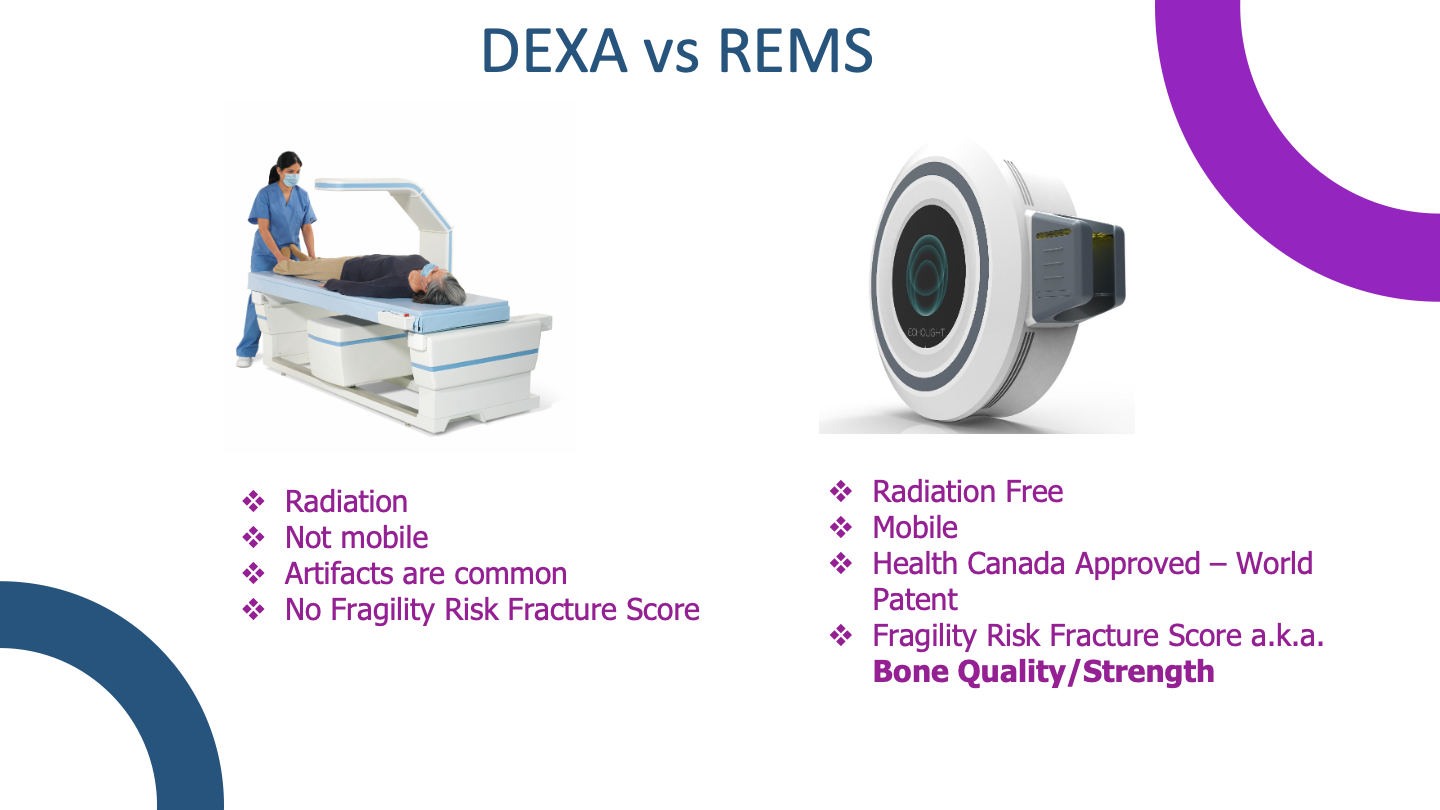
REMS and DXA are different technologies.
DXA — Dual-energy X-ray Absorptiometry uses a very low dose of ionizing radiation to measure bone mineral density. It remains an important and established component of osteoporosis assessment and Canadian fracture-risk guidelines.
REMS uses ultrasound and analyzes radiofrequency signals acquired from the lumbar spine and proximal femur to generate bone mineral density measurements and REMS specific information such as Fragility Score.
This does not need to become a battle of:
REMS versus DXA.
Healthcare rarely benefits when we turn useful tools into competing camps.
A better set of questions is:
What information do we have?
What are the limitations of that information?
What does it mean for this individual?
What additional information might be helpful?
And what should happen next?
The technology is a tool.
Informed healthcare decisions still require people, context and clinical judgment.
When Do Canadian Guidelines Recommend Bone Mineral Density Testing?
This is an important distinction.
REMS availability does not change Canada's existing clinical guidelines for osteoporosis screening and medical management.
The 2023 Osteoporosis Canada Clinical Practice Guideline recommends BMD screening generally beginning:
- at age 70 for people without risk factors
- between 65 and 69 where one clinical risk factor is present
- between 50 and 64 where there has been a previous osteoporosis-related fracture or at least two clinical risk factors
Risk factors identified in the guideline include previous fragility fracture after age 40, glucocorticoid exposure, recurrent falls, parental hip fracture, low BMI, secondary osteoporosis, current smoking and higher alcohol consumption.
Osteoporosis Canada — Quick Reference Clinical Practice Guideline
But there is another conversation worth having.
Meeting the criteria for a particular medical screening test and being interested in understanding your bone health are not exactly the same thing.
We don't wait until age 70 to care about our heart, muscles, nutrition, movement or metabolic health.
Why would we assume our skeleton doesn't deserve attention until later life?
The appropriate assessment and when to have it should always be considered within the context of the individual.
But bone-health education can begin much earlier.
Why Does Bone Health Matter So Much?
Osteoporosis is often described as a silent disease because bone deterioration can occur without obvious symptoms.
For some people, the first warning sign is a fracture.
And the consequences can be significant.
According to the Public Health Agency of Canada, in 2019–2020 there were 156 hip fractures per 100,000 Canadians aged 40 and older.
Even more sobering:
More than 1 in 5 Canadians who sustained a hip fracture died from any cause within the following year.
Canada also has a significant osteoporosis care gap.
After fractures at sites commonly associated with osteoporosis, Public Health Agency of Canada surveillance data showed that only 15% of Canadians aged 40+ received a subsequent BMD test.
This isn't about frightening people.
It is about asking a bigger question:
Why do we so often wait until something goes wrong before we become curious about our health?
Public Health Agency of Canada — Osteoporosis and Related Fractures in Canada
What Happens After a REMS Bone Scan?
This is where the Wallis for Wellness — Beyond Your Scan Experience is intentionally different.
Because we don't believe a scan should end when someone hands you a report.
That's where the conversation should begin.
Technology can give us extraordinary information.
But if you leave your appointment holding numbers, scores and terminology you don't understand, have we truly empowered you?
We don't think so.
That's why every Wallis for Wellness REMS assessment is part of something larger:
The Beyond Your Scan Experience
Our goal is to help you move from simply receiving information to understanding what that information means and what your next best step may be.
Your experience includes three important pieces.
1. Your REMS Bone Health Assessment
Your REMS assessment provides information about your bone health, including BMD, T-score, Z-score and additional REMS-derived measures such as Fragility Score.
You receive your report so you have information you can keep and share with the appropriate members of your healthcare team.
But we don't stop there.
2. Your One-on-One “What Now?” Educational Consultation
Those may be the two most important words after receiving almost any health report:
What now?
After your REMS assessment, you receive a one-on-one educational consultation with a Wallis for Wellness Patient Education Consultant.
This consultation is not about diagnosing you or prescribing medical treatment.
It is about helping you better understand the information in front of you.
Together, we help you explore questions such as:
What does my report actually say?
What do these numbers mean?
What questions should I consider asking my doctor or healthcare provider?
Are there areas of my lifestyle or health that deserve more attention?
Who else might belong on my healthcare team?
What is my next best step?
Patient empowerment should never mean replacing healthcare professionals.
It should mean helping patients become better prepared to work with them.
From Information to Action: Exploring Your Bone-Health Toolbox
Understanding your REMS results is only the beginning.
One of the goals of the Beyond Your Scan Experience is to introduce you to evidence-informed tools, resources and conversations that may help you determine your next best step, with your healthcare team where appropriate.
One technology you can explore during your Wallis for Wellness REMS appointment is the Marodyne Low Intensity Vibration Plate
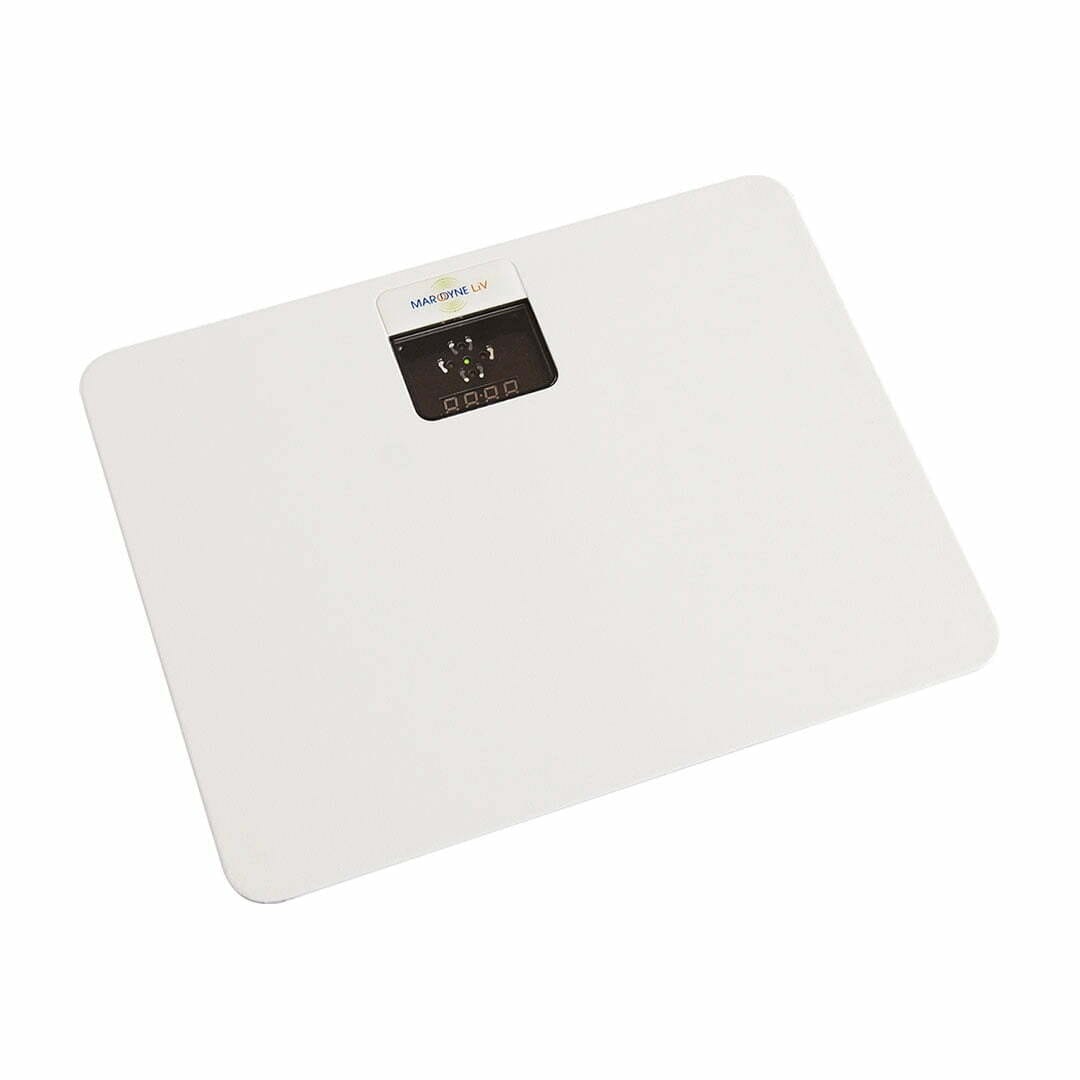
Unlike conventional fitness vibration plates, Marodyne LiV is a medical-grade low-intensity vibration device designed for home use. It delivers a gentle mechanical signal at 30 Hz and 0.3g while you simply stand on the device. Marodyne positions the technology as a non-invasive option to support bone and muscle health and says it may be used alongside an existing treatment plan depending on the individual and their healthcare provider's guidance.
And here's the part we love: you can experience it for yourself.
At participating Beyond Your Scan appointments, you'll have an opportunity to try the Marodyne LiV and learn more about low-intensity vibration as one of the tools that may be considered as part of a broader bone-health strategy.
Because your “What Now?” isn't one-size-fits-all.
It may include conversations about resistance and impact exercise, nutrition, protein, calcium and vitamin D, balance, muscle strength, medications, hormones, falls prevention and innovative technologies such as low-intensity vibration.
The goal isn't to tell you what to do. It's to help you understand the options available so you can ask better questions of your integrative health team and build the right toolbox for you.
Learn more about Marodyne LiV in Canada
3. Three Months Inside the Beyond Your Scan Education Portal
Your education doesn't end when you walk out the door.
Every Beyond Your Scan Experience includes three months of access to the Beyond Your Scan online education portal.
This growing educational environment has been designed to help you continue learning at your own pace, return to information after your appointment and begin building your personal health toolbox.
Wallis for Wellness is supported by the medical leadership of Dr. Kristy Prouse, MD, FRCSC, Medical Advisor, bringing an important clinical perspective to the educational experience.
Inside the portal, patients can access resources including:
- educational videos from Dr. Prouse and other integrative healthcare professionals
- deeper education about REMS
- guidance to help understand the different components of your REMS report
- education about bone density, bone quality & body composition
- information about Fragility Score
- research and trusted educational resources to share with your healthcare team
- downloadable education and tools
- resources designed to help prepare for conversations with healthcare professionals
- a downloadable doctor's letter to support communication about REMS results
- education around movement, muscle, fascia and strength
- nutrition and lifestyle education
- sleep and recovery education
- falls-prevention and balance information
- preventative-health resources, tools
- a growing Self-Care Toolbox
And importantly, the portal isn't designed to tell you there is one magical solution.
There isn't.
Bone health is influenced by the whole person.
Your Bones Don't Live in Isolation
The skeleton is not an inert frame holding us upright.
Bone is living tissue that continuously adapts and remodels.
Bone and fracture health can be influenced by many factors, including:
- genetics
- age
- hormones and menopause
- medical conditions
- medications
- nutrition
- calcium and vitamin D
- protein intake
- resistance exercise
- weight-bearing and appropriate impact activity
- muscle mass and strength
- balance
- falls risk
- smoking
- alcohol
- sleep and recovery
- overall health and lifestyle
Canadian guidelines recommend balance and functional training along with progressive resistance training more than twice weekly to help reduce falls and maintain or improve physical functioning, quality of life and bone strength.
Osteoporosis Canada — Exercise and Bone Health Recommendations
This is why we need to stop thinking about osteoporosis as only a bone problem.
Muscle matters. Fascia matters
Balance matters.
Nutrition matters.
Hormones matter.
Movement matters.
Lifestyle matters.
And your healthcare team matters.
There is rarely one answer.
There is a toolbox and the best philosophy is to work better together with YOU at the centre of your care.
Where Can I Get a REMS Bone Scan in Canada?
REMS is increasingly becoming available through healthcare clinics and providers in Canada.
Through Wallis for Wellness — Beyond Your Scan, our mission is to make REMS more accessible by bringing it to clinics, corporations and communities across Canada, while also providing assessments from our headquarters at Priority One Osteo & Wellness, 600 Brant Street in Burlington, Ontario.
Our Wallis for Wellness REMS Road Trip allows us to meet people where they are, bringing innovative technology, education and the full Beyond Your Scan Experience directly into communities and businesses.
New clinic locations continue to be added.
If you are a healthcare provider, clinic owner, community organization or employer interested in bringing the Beyond Your Scan Experience into your community, we also welcome opportunities to collaborate.
REMS Bone Scan FAQ: What Canadians Want to Know
1. What is a REMS bone scan?
REMS stands for Radiofrequency Echographic Multi-Spectrometry.
It is an ultrasound-based technology developed by Echolight that assesses bone health at the lumbar spine and proximal femur/hip.
REMS does not use ionizing radiation and can provide BMD, T-score and Z-score measurements as well as a REMS-derived Fragility Score.
2. What is the difference between REMS and a DXA bone density test?
Both technologies can provide information about bone mineral density, but they obtain that information differently.
DXA uses a very low dose of ionizing radiation.
REMS uses ultrasound and analyzes radiofrequency signals obtained from the lumbar spine and proximal femur.
REMS also generates a Fragility Score designed to provide additional information related to skeletal fragility independently of BMD.
DXA remains part of established Canadian osteoporosis guidelines. REMS should not automatically be viewed as a replacement for DXA or individualized medical assessment.
The important issue is determining what information is appropriate for the individual and how it should inform the broader healthcare conversation.
3. Does a REMS bone scan use radiation?
No.
REMS is ultrasound-based and does not use ionizing radiation.
This is one of its important technological differences from DXA.
4. How long does a REMS bone scan take?
The ultrasound acquisition itself is quite fast.
Echolight reports approximately 80 seconds for the lumbar spine and 40 seconds for a femoral scan.
Your complete Beyond Your Scan appointment is longer because appropriate preparation, positioning, acquisition, report generation and education all form part of the experience.
5. Does a REMS scan hurt?
REMS is a non-invasive ultrasound assessment.
You lie on an examination table while a trained practitioner moves an ultrasound probe over the appropriate assessment areas.
There are no injections, no enclosed scanning chamber and no ionizing radiation.
6. What does REMS tell me about bone quality?
REMS generates a measurement called the Fragility Score, derived from analysis of the ultrasound signal and designed to provide information about skeletal fragility independently of BMD.
Research has examined its association with future fracture risk and suggests it may add clinically useful information beyond BMD measurements alone.
However, Fragility Score — like BMD — is one piece of a larger clinical picture.
7. Do I need a doctor's referral for a Wallis for Wellness REMS assessment?
A physician referral is not required to book a private Wallis for Wellness REMS assessment.
However, REMS does not replace your physician or other healthcare professionals.
Where results identify questions or concerns, we strongly encourage individuals to discuss them with an appropriate healthcare professional.
That's one reason our Beyond Your Scan portal includes tools designed to help you prepare for those conversations, including a downloadable doctor's letter.
Patient empowerment should bring patients and healthcare professionals closer together — not push them apart.
8. What happens after my REMS scan?
With Wallis for Wellness, receiving your report isn't the end of your appointment experience.
It is the beginning of the Beyond Your Scan Experience.
You receive:
Your REMS report
A one-on-one “What Now?” educational consultation
and
Three months of access to the Beyond Your Scan Education Portal.
Inside the portal, you'll find videos, research, report education, downloadable resources, healthcare-conversation tools and a growing Self-Care Toolbox to help you continue learning.
We encourage you to submit your receipt from your scan to your extended health insurance company for possible reimbursement under diagnostic test for osteoporosis or under your health spending account.
The educational experience is supported by the medical leadership of Dr. Kristy Prouse, MD, FRCSC, Chief Medical Advisor to Wallis for Wellness.
Because our goal isn't simply to help you know your numbers.
It's to help you understand your health well enough to participate in what happens next.
The Scan Gives You Information. What You Do Next Matters.
After more than three decades working in healthcare, one lesson continues to guide me:
People make better health decisions when they better understand their bodies.
Technology can give us extraordinary information.
But technology isn't the hero of this story.
You are.
The goal isn't to collect more reports, more lab results or more numbers that sit unread in a folder.
The goal is to use information to:
ask better questions, have better conversations, build the right healthcare team,
and
make informed decisions about the health of your tomorrow.
That's what it means to Become the CEO of Your Health.
And that's why, at Wallis for Wellness, we don't believe your experience should end with the scan.
We believe it should begin there.
Trusted Resources & Further Reading
Echolight — REMS Technology
Information from the manufacturer about REMS technology, Fragility Score and EchoS.
Visit Echolight
Echolight — REMS FAQs
Technical and patient information about REMS assessment and scan times.
Explore Echolight FAQs
Osteoporosis Canada — 2023 Clinical Practice Guideline
Canadian recommendations for osteoporosis assessment, BMD screening, fracture-risk assessment, exercise and management.
View the Osteoporosis Canada Quick Reference Guide
Public Health Agency of Canada — Osteoporosis and Related Fractures
Canadian surveillance information regarding fractures, mortality and the osteoporosis care gap.
View the Government of Canada resource
Peer-Reviewed Research — Fragility Score and Incident Fractures
Five-year prospective research examining REMS Fragility Score and incident fragility fractures.
Read the Fragility Score study
REMS in Osteoporosis — State of the Art Review
A review of the evidence surrounding REMS in osteoporosis diagnosis and management.
Read the scientific review
About Margaret Wallis-Duffy
Margaret Wallis-Duffy, RMT, CPCA is a an award winning RMT, healthcare entrepreneur, educator and preventative-health advocate with more than three decades of clinical experience.
She is the founder of Wallis for Wellness, the visionary behind the Health Canada recognized Preventative Health Awareness Movement, and creator of the Beyond Your Scan Experience.
Her work centres on a simple belief:
When people feel seen, heard, believed and supported in their health, they are better equipped to participate in it.
Through education, collaboration, innovative healthcare technology and community, Margaret's mission is to help more people move from being passive recipients of healthcare to informed participants — to Become the CEO of Your Health.
Medical disclaimer: This article and the Beyond Your Scan educational resources are intended for general education and are not a substitute for individualized medical advice, diagnosis or treatment. REMS findings should be interpreted within the context of the individual's complete health history and discussed with an appropriately qualified healthcare professional where indicated.