
Hold the Vision High. Do the Hard Work.

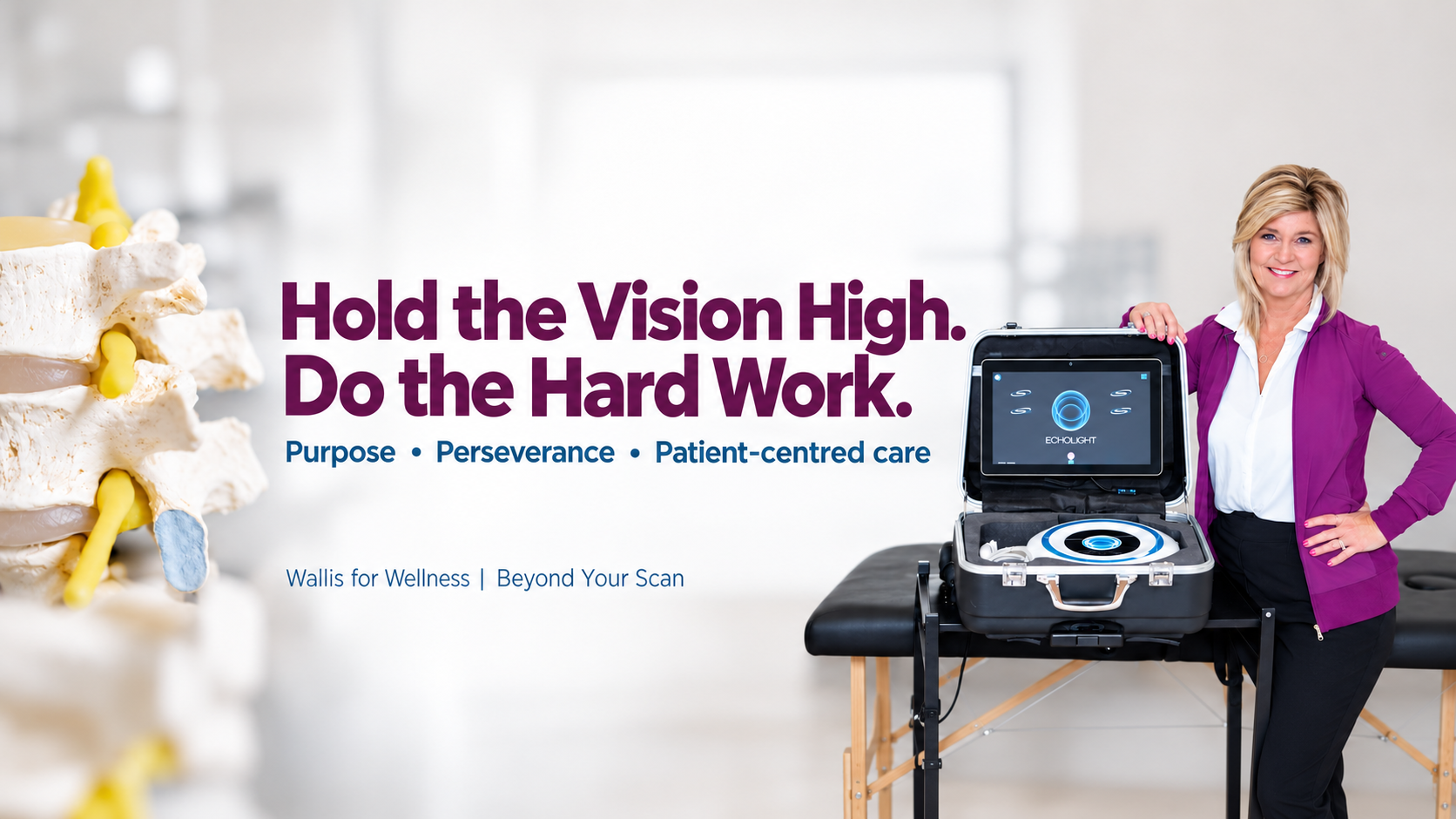
What building Wallis for Wellness — Beyond Your Scan has taught me about purpose, perseverance and patient-centred care.
My biggest, most audacious goal is to change the legacy of healthcare: to move beyond a “pill for an ill” mentality toward a more preventative, proactive and patient-empowered approach, one that helps people understand their health and take informed action sooner.
That vision has guided my work for 34 years. Tomorrow, it takes another meaningful step forward into the next chapter of this ever evolving Wallis for Wellness story.
Tomorrow, October 5, we welcome our first official community clinic patients to Wallis for Wellness — Beyond Your Scan.
I am excited. I am grateful. And if I am being honest, I am tired.
Because behind this launch is a part of building a business and pursuing a bigger dream that we do not always talk about.
The unexpected curveballs. The eleventh-hour pivots. The moment you think you have everything in place, only to discover yet another requirement that needs your attention.
There have been moments when I have wanted to throw in the towel.
But my vision has remained crystal clear: help people understand their health, provide education, technology and support to act earlier so they can feel more confident participating in their care.
When the work got harder, that vision became even more important.
A bigger dream asks more of you
It is one thing to feel inspired by an idea. It is another to carry it through the demanding, often exhausting work required to make it real.
I understand why people sometimes step away from their dreams or decide to walk away from entrepreneurship. There are real limits to our time, energy and resources. Passion does not make those pressures disappear.
For me, this launch has meant returning to the same questions: Who are we building this for? What do they deserve? What needs to be in place to serve them well?
The answers have kept me moving.
They have also required me to adapt.
Holding the vision high means being willing to change the plan, roll up your sleeves and do the necessary work. It means building a foundation that can carry the responsibility of what you are offering.
In healthcare, that foundation must include integrity, honesty, compliance and patient-centred care.
For us, that means being transparent about what we offer, following the applicable professional standards and regulatory requirements, and putting the right expertise and support in place so we can operate with integrity and build a sustainable business that serves patients well for years to come.
Every pathway, professional role and patient handoff deserves attention. Especially when you are introducing a new technology, it is critical to bring it to Canadians in a professional and responsible way.
That is how Wallis for Wellness- Beyond Your Scan has been built: deliberately, thoughtfully and with a commitment to quality care for the people we will have the privilege of scanning.
The vision has been taking shape for 34 years
As a Registered Massage Therapist with a background in kinesiology, I have spent 34 years helping people understand their musculoskeletal system and navigate changes in pain, movement and function.
As the founder of Wallis for Wellness, an award-winning preventative and integrative health clinic that I led for 30 years, I worked to break down silos and bring conventional and complementary healthcare professionals together. We learned and grew from one another, united by one mission: helping the everyday people we had the honour of treating achieve the best possible outcomes through collaborative care, education and empowerment. The lessons I learned from building and leading that clinic are now shaping Beyond Your Scan, carrying that same mission forward.
My belief in preventative and integrative healthcare has guided my practice, my business and the relationships I have built along the way.
I remember hesitating to hang my massage therapy diploma because before our profession was regulated under the RHPA - Regulated Health Professions Act , it used the word “masseuse.” This did not in any way reflect the healthcare professional I knew myself to be, or the contribution I believed our profession would make for years to come.
I held that vision then. I hold it now.
Bone and muscle health belong together in the conversation about mobility, independence and quality of life. Bringing new assessment tools into a collaborative model of care feels like a natural continuation of that work.
Innovation asks us to think differently
I am drawn to innovation that makes us ask better questions.
That is what first attracted me to Echolight REMS, a Health Canada–licensed ultrasound technology for bone health assessment.
DXA, commonly called DEXA, entered routine clinical practice in 1987 and remains the established foundation of osteoporosis assessment. It has served healthcare for nearly four decades.[1]
REMS brings a different approach.
It analyses the frequency characteristics of raw ultrasound signals from the spine and hip, comparing them with reference models to estimate bone mineral density. Its software can identify and exclude certain signals affected by artefacts, including degenerative changes or calcifications that can complicate DXA interpretation.[2]
That is a meaningful distinction. It also makes qualified acquisition and quality control essential: REMS still requires appropriate technique, positioning and training.
The opportunity extends beyond density. Its Fragility Score uses ultrasound signal patterns associated with skeletal fragility to provide additional information related to bone quality and fracture risk. It is an indirect assessment, rather than a direct image of microscopic bone architecture.[3]
For healthcare professionals and patients, that opens a valuable conversation about what contributes to bone strength.
The evidence is moving the conversation forward
On October 1, 2026, Nature Reviews Rheumatology published a review examining emerging tools for fracture-risk assessment, including REMS.
It highlights a critical limitation of density alone: approximately half of hip fractures occur in people whose bone density is outside the osteoporotic range. The review describes growing evidence for tools that add information about skeletal fragility beyond BMD.[3]
A prospective study published in Aging Clinical and Experimental Research found that the REMS Fragility Score predicted incident fractures over five years better than the DXA and REMS BMD T-scores evaluated in that study.[4]
These findings are one of the many reasons I am excited about REMS.
More information can help us ask better questions. It must also be interpreted responsibly, alongside medical history, previous fractures, medications and other risk factors.
A low Fragility Score does not, by itself, cancel an osteoporosis diagnosis or establish that medication is unnecessary. Treatment decisions belong in a personalized conversation with the clinician responsible for your care.
That is exactly why the experience around the scan matters.
Earlier information should lead to meaningful action
Osteoporosis Canada reports that at least one in three women and one in five men will experience an osteoporotic fracture during their lifetime. Most people reach peak bone mass by approximately age 30.[5]
Prevention deserves attention long before a fracture.
In Ontario, OHIP’s bone-density testing rules changed effective April 1, 2026. For adults over 50, repeat DXA testing is generally covered every five years for patients who are not high risk, and every three years for high-risk patients or therapy monitoring. Earlier testing may be covered for specific clinical reasons, including a new fragility fracture or risk factors for rapid bone loss. For these repeat-testing rules, OHIP defines high risk as an estimated major osteoporotic fracture risk above 15%, using FRAX or an equivalent tool.[7,8]
The age recommendations are a separate piece: Osteoporosis Canada recommends BMD screening at 70 for people without risk factors, with earlier assessment when specified risk factors are present. OHIP permits baseline testing after 50 in accordance with screening guidelines, and earlier in certain clinical circumstances.[7,9]
This is one reason I see value in an additional, clinically guided pathway to bone health assessment. REMS may help bridge access and monitoring gaps for people who would benefit from looking sooner. It is a privately paid option through our service, with testing recommended according to individual clinical needs.
Bone loss can develop silently. My goal is to replace uncertainty with understanding and help people move from fear into informed action. When assessment leads to appropriate care, strength and balance training, nutrition and follow-through, we have an opportunity to reduce fracture risk before a life-changing injury occurs.
Our service welcomes adults 21 and older, subject to clinical review and an appropriate requisition. Because REMS uses no ionizing radiation, radiation exposure does not limit repeat assessments. The timing and value of testing still depend on each person’s clinical circumstances.[2]
Its portability also creates opportunities to bring assessment closer to people, in rural communities, seniors’ residences, workplaces and healthcare settings.
The goal is to turn useful information into appropriate action.
That may include progressive resistance and balance training, adequate protein and overall nutrition, and attention to conditions or medications affecting bone health. Impact or jump training may be suitable for some people, with exercise adapted to fracture risk and physical ability. Canadian osteoporosis guidelines emphasize exercise, nutrition and individualized fracture-risk assessment alongside treatment when indicated.[6]
It may also mean discussing hormonal changes, sleep, digestive conditions or other health concerns with the appropriate professional.
As an RMT with a kinesiology background, education about movement and musculoskeletal health is close to my heart. Collaboration allows each professional to contribute their expertise while keeping the whole person in view.
The deliberate build behind Beyond Your Scan
The technology opened the door. We have worked hard to build the medical oversight and patient supported experience around it.
Wallis for Wellness — Beyond Your Scan includes:
- A referral pathway: An appropriate requisition from your family doctor or through our nurse practitioner’s clinical review, as required for diagnostic ultrasound under Ontario’s RHPA regulatory framework. Your scan is performed by a CMRITO-registered Diagnostic Medical Sonographer, supporting qualified, accountable care.
- Qualified scanning: REMS assessments performed by CMRITO-registered Diagnostic Medical Sonographers trained in the technology.
- Your report and an educational handoff: helping you understand the process and organizing your next steps.
- A personalized nurse practitioner consultation: reviewing your results in the context of your health and discussing recommendations for you.
- Three months of access to our Beyond Your Scan educational portal: multimedia education developed in collaboration with Dr. Kristy Prouse, our Chief Medical Advisor, including videos explaining your report, lifestyle education, research, resources and a letter to share with your doctor to help you effectively advocate for your health.
The portal gives you time to revisit information, prepare questions and bring those conversations to your healthcare team.
I call that building health esteem: greater confidence in your ability to understand your health, ask questions and take an active role in decisions.
It is central to helping people become the CEO of their health, supported by professional expertise.
Bringing people with us
Introducing a new tool carries a responsibility to educate.
We are committed to sharing the evidence with healthcare professionals listening to their questions and creating opportunities to see REMS in action. That includes educational presentations for clinical teams and conversations with researchers, insurers and community partners.
Community has always been part of my bigger vision.
As the founder of The Preventative Health Awareness Month and Movement (PHAM), recognized by Health Canada and approaching its fifth year, I am proud that an idea I put into action as grown into a powerful and passionate grassroots network of more than 100 healthcare professionals, with engagement across levels of government.
That experience has reinforced my belief in what becomes possible when people work together.
It feels fitting that our first official clinic on October 5 takes place in a rural community at Exeter Massage and Integrative Care, thanks to the leadership of fellow RMT Stephanie Vandenbussche, who shares this vision.
On October 6, we launch our Burlington headquarters in collaboration with Priority One Osteo & Wellness at 600 Brant Street.
To our growing team, our chief medical advisor- Dr. Kristy Prouse MD, FRCSC and our clinical and community partners: thank you for helping me build this with such care.
We are just getting started
Speaking at the Strength Summit at Farm Girl Fitness and The Baby Show Toronto at the Enercare Centre reminded me how much people want practical education and a stronger health toolbox.
Our REMS Road Trip is ready to grow through community partnerships, with a vision of reaching more Canadians.
If you would like us to visit your community or workplace, collaborate with your clinic, or speak at your event, please reach out.
Explore our clinics and book your Beyond Your Scan appointment.
Tomorrow marks a beginning. It also reflects 34 years of believing in prevention, education and collaboration.
If you are carrying a bigger dream through a difficult season, this is what I would share: keep returning to the people and purpose behind it. Let that guide the decisions and the work.
Hold the vision high. Build the foundation carefully. Keep going with integrity.
Together, we can change the legacy of healthcare.
Let’s not wait until we break.
Research and resources
- The role of DXA bone density scans in the diagnosis and treatment of osteoporosis. https://pmc.ncbi.nlm.nih.gov/articles/PMC2600106/
- Fuggle et al. Radiofrequency echographic multi spectrometry (REMS) in the diagnosis and management of osteoporosis: state of the art. 2024. https://pmc.ncbi.nlm.nih.gov/articles/PMC11192661/
- Honvo et al. Single-component imaging and ultrasound-based tools for the assessment of fracture risk. Nature Reviews Rheumatology, October 1, 2026. https://www.nature.com/articles/s41584-026-01436-9
- Fragility Score: a REMS-based indicator for the prediction of incident fragility fractures at 5 years. 2023. https://pmc.ncbi.nlm.nih.gov/articles/PMC10115670/
- Osteoporosis Canada. Facts and Stats. https://osteoporosis.ca/facts-and-stats/
- Clinical practice guideline for management of osteoporosis and fracture prevention in Canada: 2023 update. https://pmc.ncbi.nlm.nih.gov/articles/PMC10610956/
- Ontario Ministry of Health. Bulletin 260804: Additional Schedule of Benefits changes effective April 2026. https://www.ontario.ca/document/ohip-infobulletins-2026/bulletin-260804-additional-schedule-benefits-changes-effective
- Ontario Ministry of Health. Schedule of Benefits, effective April 1, 2026, Bone Mineral Density Measurement. https://www.ontario.ca/files/2026-03/moh-schedule-benefit-2026-03-27.pdf
- Osteoporosis Canada. Quick Reference Guide: 2023 Clinical Practice Guideline. https://osteoporosis.ca/quick-reference-guide-clinical-practice-guideline/