
Who's in your Circle? Why Community Matters to your Health

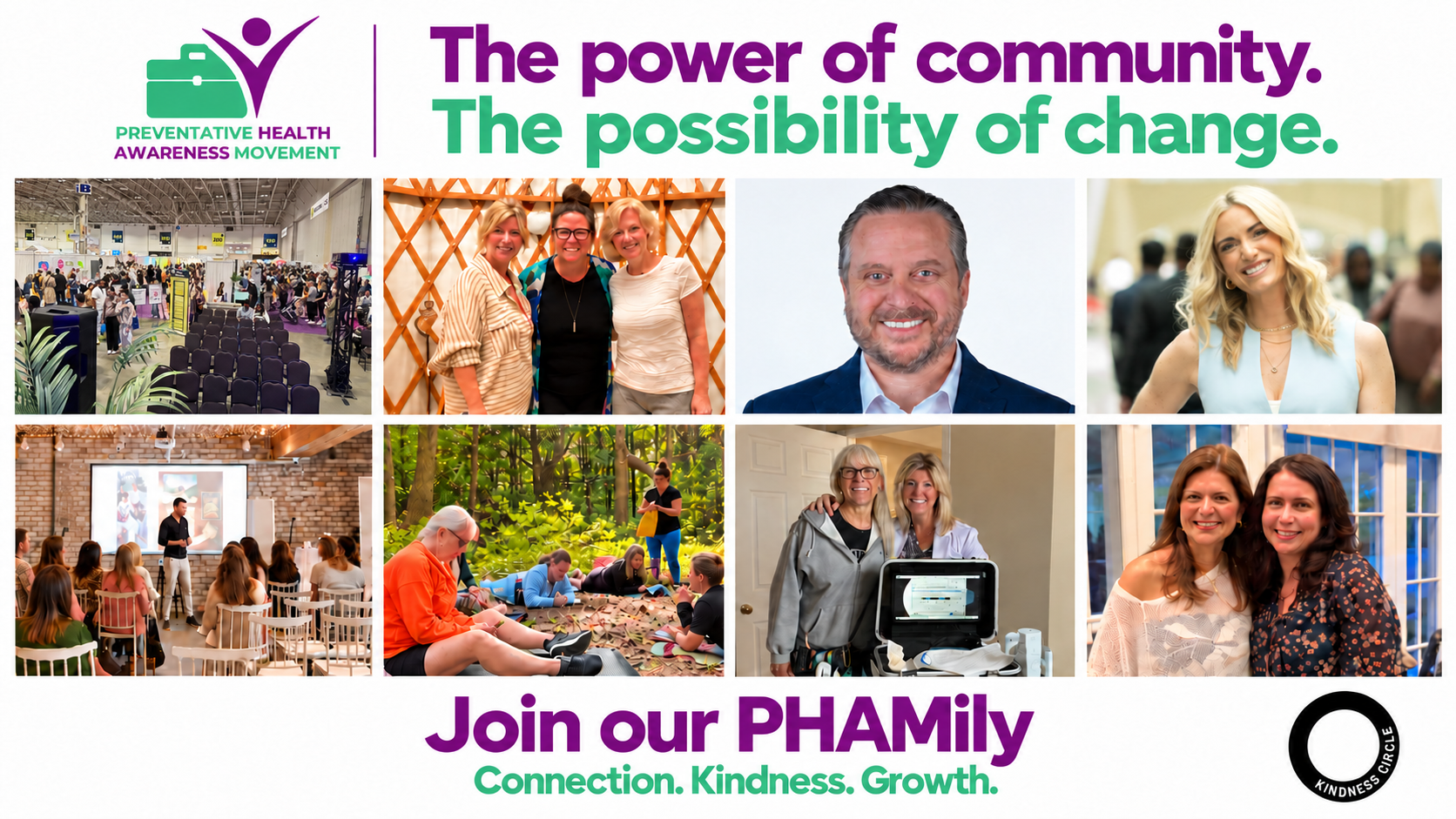
What stepping into new rooms has taught me about growth, belonging and creating change together.
By Margaret Wallis-Duffy R.M.T.
When I sold Wallis for Wellness in April 2022, I felt proud of what we had built over 30 years. But there was something I missed more than I had expected.
The conversations that happened without an appointment.
Someone pausing at the front desk. Two people discovering a connection in the waiting room. An unexpected reunion. A community gathering to celebrate, or to help a family going through something difficult.
Those moments were part of the care.
As I approach five years since selling the clinic, I understand more clearly what I was missing: the everyday experience of belonging.
And I keep returning to this: who we surround ourselves with deserves a place in the conversation about our health.
More connected and still missing connection
Over the past decade, more of our daily lives have moved online. Statistics Canada reported that 95% of Canadians aged 15 and older used the internet in 2022, up from 92% in 2020.[1]
Then the pandemic disrupted many of the places where connection happened naturally. A 2022 systematic review and meta-analysis found a small average increase in loneliness during the pandemic, with substantial differences between studies.[2]
That distinction matters. We did not all experience those years in the same way.
Technology also helped us through them. For someone who is housebound, geographically isolated or unable to find support nearby, an online community can be profoundly meaningful. I use digital tools to share education and bring people together myself.
But I am asking a question of my own habits: Is this helping me connect, or simply keeping me occupied?
A feed can fill an evening while leaving a need for companionship unmet.
In 2025, the World Health Organization reported that approximately one in six people worldwide experiences loneliness. Its report identifies social disconnection as a serious concern for both mental and physical health.[3]
We need to take belonging seriously.
Connection reaches beneath the surface
I sometimes describe the “energy” of a room: the way I feel more settled, hopeful or open around certain people.
Psychology and neuroscience offer ways to understand some of what we experience in supportive company.
In a small laboratory study, women anticipating an electric shock showed reduced activity in brain systems involved in responding to threat while holding their husband’s hand. The findings were strongest in higher-quality marriages.[4]
That experiment does not prove that every gathering improves health. It does illustrate something powerful: supportive relationships can influence how the brain responds to a stressful situation.
When I say that someone’s presence helps me feel safer, there can be more happening than a comforting idea.
The stories we bring into the room
Of course, we bring ourselves into every room, including the stories we have rehearsed.
I am behind. I do not fit here. Everyone else knows what they are doing.
I have learned to notice when a story is quietly making a decision for me.
Sometimes growth begins with entering the room before I feel ready, then discovering that the people inside are human too.
Research also offers an interesting reminder about our interpretations. A 2025 series of studies found that beliefs about being alone were associated with how lonely people felt during time alone. An experiment within that research showed that reading about the benefits of solitude could shift people’s beliefs about it.[5]
This does not mean loneliness is a mindset failure. It means the meaning we give an experience can matter.
People often see me as an extrovert. I also love my own company and need time to return to myself.
Restorative solitude and unwanted loneliness are different experiences. I want room in my life for quiet and for community.
And community must allow disagreement. I want people who share a commitment to kindness, while bringing experiences and ideas that challenge mine. Belonging should make it safer to think differently.
What are we making room for?
Yesterday, I was talking with my daughter-in-law, a compassionate, bright social worker who works with children.
We spoke about technology, development and the space left for children simply to be themselves. We also talked about art, language, music and human interaction.
Research on adolescents suggests that relationships between social media use and life satisfaction can vary by age and sex, and can run in both directions.[6] We should resist explaining every difficulty through a screen.
Still, we can ask what screen use may be crowding out.
Making something with our hands, listening without checking a notification, playing music together or having a conversation that wanders somewhere unexpected.
Perhaps the pendulum needs a conscious nudge toward presence.
There is research behind making room for creativity, too. A 2019 World Health Organization scoping review drew together evidence from more than 3,000 studies on the arts and health. It described ways that participation in the arts can support well-being, emotional expression and social connection. The evidence covered many different activities and study designs; it does not mean every creative gathering produces the same benefits.[7]
For me, it reinforces the value of offering different ways to take part. A conversation may open a door for one person. Art or music may help someone else express something they have struggled to put into words.
That is why, as part of PHAM’s fifth anniversary in February 2027, we are creating the Art of Prevention, a community art installation shaped by the people it represents.
Community members will be invited to add their handprints and share what health and prevention mean to them and their families. Together, those individual contributions will form a visual expression of each community’s unique identity, proudly displayed as a reminder of both our differences and what we share.
Every handprint will belong to a person with their own story. Seen together, they will offer a simple reminder: each of us has a place in the picture, and a part to play in creating a healthier future.
The people helping me grow
The rooms we choose shape the lives we live.
These reflections have changed how I spend my time. Over the past few months, I have deliberately sought out people and communities that help me feel supported, challenge my thinking and encourage me to grow.
Sometimes I have walked into unfamiliar rooms alone, carrying that familiar question: Will I belong here? I have paid attention to what happens afterward: how I feel about myself, how I see the world and whether a goal that felt overwhelming now feels possible.
I sought out Legacy League, founded by talented leaders Kim Fitzpatrick and Kyle Hosick, because I wanted to feel both supported and challenged in my business. I wanted to expand my network, stretch my thinking and move toward my goals with people who encourage growth, think creatively and thrive in community.
Through Thrive & Rise Academy, curated by Angie Mercier and Dana Liebermann Finestone, I have found a welcoming space for women from different walks of life to be in a community that encourages growth and impact through thoughtful, strategic leadership. Sometimes room to reflect helps us recognize what we need next.
Heart-Wired CEO, led by Marsha Vanwynsberghe and Meghan Weir, speaks to something I deeply value: pursuing business success while leading from the heart and paying attention to our nervous systems. Their approach reminds me to consider how I feel as I build, alongside what I achieve.
Kim Basler’s Sisterhood Circles offered me another important invitation. We do not have to hold everything alone. There is value in having somewhere to set down what we are carrying, feel witnessed and reconnect with ourselves and others.
And Farm Girl Fitness, founded by Jessie Thomas, brings together something I have believed throughout my career: a strong body, a strong mind and a strong community belong in the same conversation.
These spaces meet different needs in my life.
Each encourages me to get curious about myself and another human being. After 34 years in business, that curiosity still gives me energy.
We do not have to keep doing what we have always done. Experience gives us a foundation. We can still open ourselves to different ways of learning, growing and contributing.
Curiosity close to home
I have been practising that same intention in my own community, reaching out for coffee conversations with people willing to step into municipal leadership: local entrepreneur Jason Brass, running for mayor of Halton Hills; Chantal Garneau, running for regional councillor and Anita Bergsma, running for local councillor.
I wanted to learn about them, hear what they value about living in my hometown and understand how they hope to address our community’s challenges. Listening gives me a fuller picture than assumptions ever could.
Most recently, a soulful conversation with storytelling coach Alex Street brought me back to the power of our stories. His work explores how a story can help people see a possibility, feel a connection and move toward purposeful action. It made me reflect again on the stories I share and the ones I tell myself.
I also deeply admire Marcia Agius and the Kindness Circle, a community putting compassion into practice and celebrating the power of a smile. Their purpose resonates with a belief I return to often: kindness costs nothing, but it has the power to cause a ripple effect to change the world.
Different rooms. Different conversations. More opportunities to understand one another.

Why I call it our PHAMily
As I prepare for the fifth anniversary of the Preventative Health Awareness Movement in February 2027, I keep returning to why I chose the name PHAM.
PHAM stands for the Preventative Health Awareness Movement. When you say it aloud, you hear “fam,” the familiar shorthand for family. That play on words was intentional.
And the people who bring the movement to life are our PHAMily — P-H-A-M-I-L-Y.
Family matters. So does the family we find and build in community: people who make room for us, listen to us and help us feel that we belong.
This grassroots movement began with a pull to help change the future of healthcare in Canada: to make prevention, education and personal agency part of everyday life. To help people pursue a longer healthspan, with more years of living well.
What has grown around that idea is a network of people willing to listen, learn, collaborate and breathe belief into one another.
This past week, I have been working on the fundraising needed to support its next chapter. Bringing people together takes resources. Events, education and community celebrations require real work and real funding.
The currency of impact is real. So is the cost of creating the conditions for it.
My commitment is to work with different organizations to create more ways for people to come together. People bring different upbringings, cultures, abilities, skills and levels of comfort with sharing. Our gatherings need to make room for those differences.
That may mean a small, intimate conversation, a creative activity or a larger community event. We can invite participation without demanding disclosure. Someone should be able to listen first, contribute in their own way and know that their experience will be treated with respect.
Research on psychological safety offers a useful principle here. In a study of 51 workplace teams, Amy Edmondson found that psychological safety, a shared belief that a team is safe for interpersonal risk-taking was associated with learning behaviour.[8] That study examined workplaces, rather than PHAM gatherings. But it informs the kind of environment I want us to build: one where asking a question, admitting uncertainty or sharing a different perspective does not invite humiliation.
Bringing people into a room is the beginning. How we listen helps determine whether they feel able to participate.
Making room for your VOICE
This is where VOICE comes into our work:
- V — Value your experience. Your lived experience deserves to be heard.
- O — Open the conversation. A question or an honest exchange can be a beginning.
- I — Invite understanding. Listen with curiosity, especially when someone sees things differently.
- C — Connect in community. Build relationships where people can contribute and belong.
- E — Empower through action. Use what you learn to take an informed next step.
VOICE is a guide for how I want us to gather, rather than a clinical model. It connects the courage to speak with our shared responsibility to listen.
For this fifth anniversary, I want us to make space for voices we have not yet heard. Sometimes a meaningful beginning is a table, a question and someone willing to stay for the answer.
Beyond a result
We are only two weeks into the launch of Wallis for Wellness Beyond Your Scan, and I am seeing this lesson again.
The REMS technology is an important part of the experience. So is what surrounds it: education, a chance to ask questions, someone listening to a concern, and support in understanding the next steps you can take in community.
A person arrives with a life, a history and questions that may have been carried quietly for years.
My work keeps reminding me to make room for that person.

One act of kindness today
I feel hopeful because of the people I continue to meet: people who care deeply, share generously and want to build something better together.
We can help create that kind of community in ordinary moments.
Today, ask yourself: What is one kind thing I can do for myself, and one kind thing I can do for someone else?
Invite someone for a walk, make the call, introduce yourself or leave a chair open.
Ask a question, then stay long enough to hear the answer.
If you have been feeling disconnected, you do not have to become a different person overnight. One manageable step toward someone you trust is a beginning.
Community matters. You matter.
Sometimes kindness is simply holding space, face to face, with another human being.
And sometimes that is where a different story begins.
All of these people, organizations and movements reflect something PHAM embodies: our well-being is shaped by the lives we lead and the connections we build. Mental, physical, emotional, spiritual and financial well-being all deserve consideration. Different communities can help us attend to different parts of that picture.
There is room for these communities in our PHAMily. I would love to explore more ways to learn from one another, collaborate and bring people together. That is part of my bigger, audacious goal: to help change the legacy of healthcare in Canada and beyond, for generations to come.
I want more of this in my life and my business.
More curiosity, more connection and more opportunities to grow together.
How about you?
Join our PHAMily—as an individual, a community organization or a business that wants to contribute.
Let’s create the change we want to see, beginning with how we show up for one another.
Research sources
- Statistics Canada. Canadian Internet Use Survey, 2022.
- Ernst et al. (2022). Loneliness before and during the COVID-19 pandemic: A systematic review with meta-analysis.
- World Health Organization (2025). Social connection linked to improved health and reduced risk of early death.
- Coan, Schaefer and Davidson (2006). Lending a hand: Social regulation of the neural response to threat.
- Rodriguez, Schertz and Kross (2025). How people think about being alone shapes their experience of loneliness.
- Orben et al. (2022). Windows of developmental sensitivity to social media.
- Fancourt and Finn (2019). What is the evidence on the role of the arts in improving health and well-being? A scoping review. WHO Regional Office for Europe.
- Edmondson (1999). Psychological safety and learning behavior in work teams.