Are You Stuck in Park?

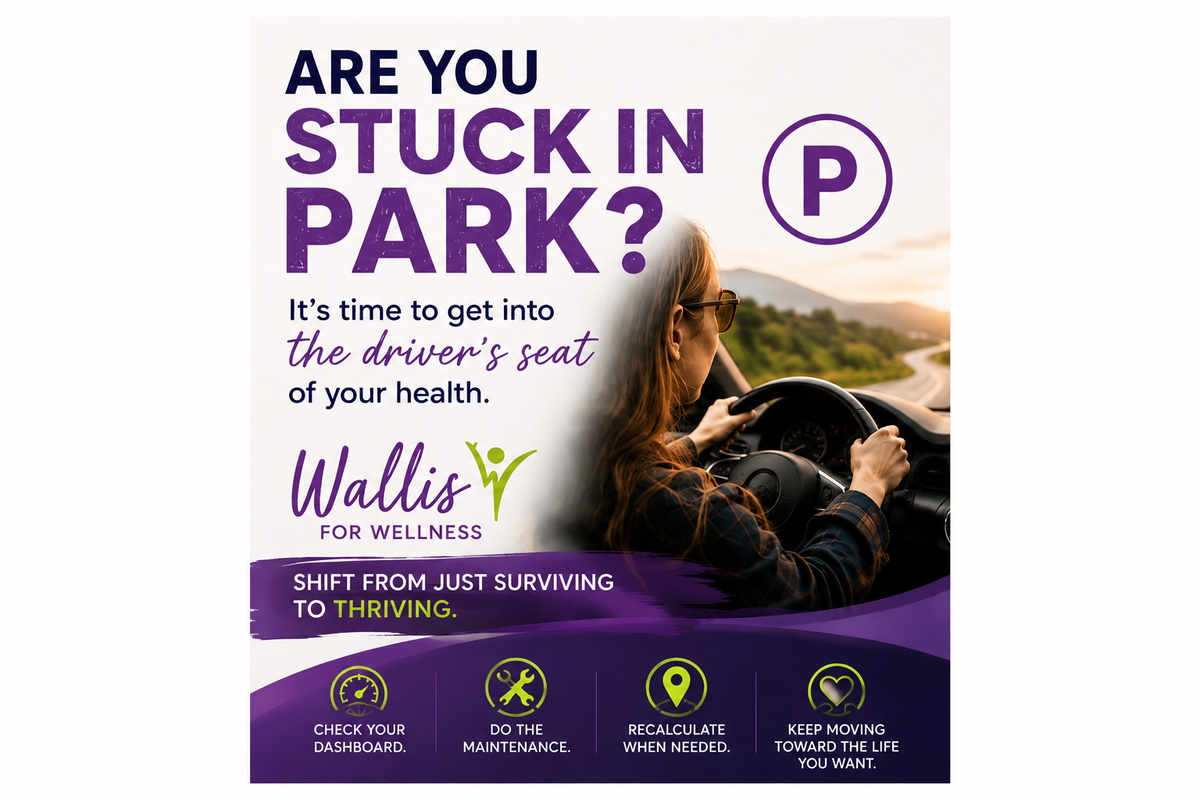
It’s Time to Get Into the Driver’s Seat of Your Health
We take surprisingly good care of our cars.
We watch the dashboard, and we pay attention when a warning light comes on.
We change the oil, check the tires, schedule regular maintenance and fill the tank.
And when something starts making a strange noise, most of us don't turn up the radio and hope it goes away.
Yet when it comes to our bodies?
We do that all the time.
We ignore the warning lights.
We normalize feeling exhausted, uncomfortable, weak or simply "not quite right."
We postpone the maintenance and sometimes we wait until something breaks down before we finally pay attention.
Maybe it's time to get into the driver's seat of our health.
Are You Stuck in Park?
For years, I've used the phrase "Become the CEO of Your Health."
It doesn't mean becoming your own doctor.
It means becoming an active participant in your health.
Pay attention, ask questions and try to understand your options. Work to build the right team around you. And take action before a warning light becomes a breakdown.
Because there is a big difference between being a passenger in your healthcare and being in the driver's seat of your health.
And sometimes the first question we need to ask ourselves is remarkably simple:
Am I moving forward, or am I stuck in park?
The Parking Industry Understands Something Health Care Needs to Embrace
Parking and mobility are changing quickly.
Digital platforms, apps, artificial intelligence, EVs, changing customer journeys, connected mobility and eventually, increasingly autonomous vehicles.
The industry can't simply say:
"This is how we've always done it."
It has to adapt.
It has to collect better information, anticipate changing needs, remove friction and continually rethink how people move from where they are to where they want to go.
Our approach to health needs some of that same thinking.
Because our lives have changed too.
We're living longer and sitting more. We're navigating enormous amounts of health information. Technology is changing what we can measure and understand about our bodies.
Yet too much of our thinking about health still begins after something has gone wrong.
What if we changed that?
Preventive Health Is Preventive Maintenance
Nobody waits for the engine to seize before changing the oil.
Nobody says:
"My tires haven't blown yet, so there's probably no point checking them."
Preventive maintenance isn't driven by fear, it's driven by information.
You inspect.
You measure.
You maintain.
You identify potential problems early.
And you make adjustments that may help keep you safely on the road longer.
That's how I'd like us to think about our health.
Not obsessively or with fear.
Proactively.
Learn your numbers and know your family history.
Pay attention to changes in your body.
Build strength and mobility.
Sleep well and move often.
Fuel yourself well and ask questions.
Attend appropriate screening.
And when your body's dashboard tells you something has changed, don't automatically cover the warning light with a piece of tape.
Get curious.
Your Body Is the Vehicle That Carries You Through Your Entire Life
We talk a great deal about longevity.
I think we need to talk just as much about the quality of the journey.
Can you get out of the car and walk where you want to go?
Carry your groceries, play with your grandchildren?
Travel, dance, work and live independently?
Participate fully in the life you've worked so hard to build?
Because adding years to life matters.
But adding life to those years matters too.
That is healthspan.
And unlike our cars, we don't get to trade our bodies in for this year's model.
Sometimes You Need to Recalculate the Route
Anyone who has used GPS knows the phrase.
"Recalculating"
You missed the exit, the road changed or their is construction ahead.
Your destination hasn't changed but the route needs to.
Health can be like that too.
Our bodies change, menopause happens and we sustain injuries. Stressors change, evidence evolves and new technologies become available.
Changing direction isn't failure.
Sometimes it's leadership.
The important thing is recognizing when the old route is no longer getting you where you want to go.
And You Don't Have to Drive Alone
Being in the driver's seat doesn't mean doing everything yourself.
Good drivers use information.
Maps, technology, mechanics, experts and signs.
Health should be no different.
Taking agency means building a collaborative healthcare team and learning enough to participate confidently in the decisions affecting your body and your future.
It means being seen, heard, believed and supported while still recognizing that ultimately, this is your journey.
From Parking Lots to Possibility
There is something wonderfully ironic about borrowing a health lesson from the parking industry.
Because parking is ultimately about stopping.
But the industry's future is increasingly about movement.
Connecting people, removing barriers, using information better.
Helping people get where they're trying to go.
Perhaps that's exactly the conversation we need in preventive health.
We need fewer people feeling parked in their health.
Fewer passengers waiting for someone else to tell them what to do.
And more people equipped with the information, confidence, resources and support to move forward.
So check your dashboard, do the maintenance, build your pit crew,recalculate when necessary.
And remember:
Your health isn't simply where you are today.
It's what allows you to get where you still want to go.
The keys are yours.🔑
Get into the driver's seat. 🚘