“My Core Has Always Been Weak”

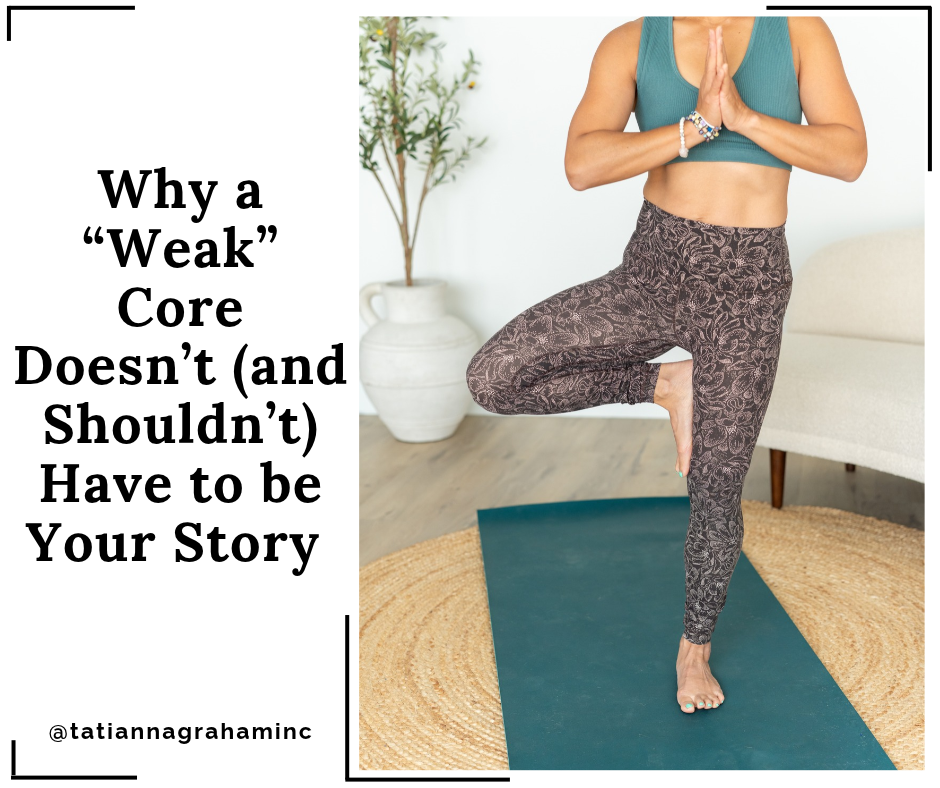
What If There's More to the Story?
By Tatianna Graham, Physiotherapist, Founder of The Move With Ease Method & Podcast
In my 15+ years as a physiotherapist, I've heard some version of these statements countless times:
“My core has always been weak.”
“I thought that was just part of aging.”
“Oh, I had a C-section. Isn't that what happens?”
“My pain tolerance is pretty high.”
“It's fine. I'm fine.”
But when I start asking a few more questions, the conversation often changes.
“Oh, actually, I've struggled with chronic constipation for years.”
“I'm bloated a lot, and my gut hurts.”
“Intimacy is uncomfortable.”
“I do leak a little when I run, but only if I don't make sure I pee first.”
"Sneezing and leaking? Oh doesn't that happen to everyone after having kids?"
What's particularly interesting to me is how many of these things weren't mentioned initially. Not because the women were intentionally withholding information, but because they had become so accustomed to managing these symptoms that they no longer thought they were worth mentioning.
And that's where I love to get curious.
When did we decide that this was just part of being a woman?
Somewhere along the way, many of us learned to associate certain physical experiences with motherhood, hormonal changes or getting older.
We cross our legs when we sneeze.
We avoid jumping on the trampoline with our kids.
We plan our outings around bathroom access.
We accept that intimacy might be uncomfortable.
We stop lifting heavy things because we're worried about our backs.
And we carry on. We are "fine".
Women are incredibly resourceful. We adapt, accommodate and find ways to keep showing up for the people we love.
But sometimes, we become so good at managing something that we forget to question whether we need to keep managing it at all.
Just because something is common doesn't mean we have to accept it as inevitable. It does not need to be our normal.
Your inner core is about so much more than abdominal strength
When most people think about their core, they picture their abdominal muscles.
Crunches. Planks. Pilates. A flat stomach.
But your inner core is a beautifully coordinated system that includes:
- Your diaphragm — your primary breathing muscle.
- Your pelvic floor — the muscles at the base of your pelvis.
- Your transversus abdominis — a deep abdominal muscle that wraps around your torso like a corset.
- Your multifidus — deep muscles that help support your spine.
These muscles work together to help manage pressure, support your spine and pelvic organs, and respond to the demands of everyday movement.
And one of the most fascinating things about this system?
It needs to be able to both generate tension AND release it.
Think about doing a bicep curl. If you kept your elbow bent and your bicep contracted all day, you wouldn't be giving that muscle the opportunity to move through its full range.
Your pelvic floor and deep abdominal muscles also need the ability to lengthen, contract and respond appropriately.
Yet so many of us have spent years learning how to hold everything in.
Pull your belly button toward your spine.
Tuck your tailbone.
Suck in your stomach.
Engage your core.
These cues may have a purpose during certain exercises, but they aren't necessarily instructions we need to carry with us throughout our entire day.
What if strengthening isn't always the first step?
One of the things I frequently discover when working with women is that they're holding tension in places they aren't even aware of.
Their jaw.
Their abdominal wall.
Their glutes.
Their pelvic floor.
Sometimes these patterns date back to childhood, dance, gymnastics or fitness classes. Sometimes they develop following pregnancy, surgery, injury or periods of increased stress.
And when we've been holding tension for long enough, it can become so familiar that we no longer recognize it as tension.
It just feels like us.
This is why I don't automatically assume that someone who describes her core as weak simply needs more strengthening exercises.
I want to understand how she's breathing.
How her rib cage moves.
Whether she can generate tension when she needs it and release it when she doesn't.
Whether she can actually feel and connect with this part of her body.
Pelvic floor dysfunction can contribute to difficulties with bladder and bowel function, pelvic discomfort and painful intimacy. However, these symptoms, along with bloating and abdominal pain, can have many different causes and deserve appropriate assessment.
The point isn't to assume that everything comes back to your core.
The point is to start asking different questions.
The connection goes beyond physical strength
Through my work as a physiotherapist, yoga teacher and movement and mindset coach, I've also become increasingly fascinated by the relationship between our breath, our inner core and our nervous system.
When life gets busy, when responsibilities pile up, or when we're navigating uncertainty, we may notice ourselves physically holding more tension.
Our shoulders creep up.
Our jaw clenches.
Our breathing becomes shallower.
Our belly tightens.
Sometimes the feeling of having to hold everything together emotionally starts showing up physically, too.
Learning to reconnect with the movement of our breath can give us another tool to support nervous system regulation.
Something we can access before a difficult conversation, during a stressful workday, or when life throws us an unexpected curveball.
Not because we can eliminate stress from our lives, but because we can practise coming back to ourselves in the midst of it.
Your inner core isn't just a foundation for movement. Your connection to it can also become an anchor for life.
Try this right now
Before you continue reading, I invite you to check in with your body.
Without trying to correct anything, simply notice:
Are your teeth clenched?
Are you pulling your stomach in?
Are you gripping your glutes?
Can you sense any tension around your pelvic floor?
Now, without forcing anything, see if you can soften just 10%.
Take a comfortable breath and notice whether you can feel movement around your lower ribs, your sides and perhaps even your back.
What do you notice?
You don't need to get it right. You don't need to achieve anything.
We're simply beginning a conversation with your body.
And sometimes, that awareness is the most valuable first rep we can practise.
You don't have to wait until something gets worse
I'm passionate about preventative health because I believe we deserve to give our bodies attention long before they demand it.
You don't need to wait until your back pain stops you from exercising.
You don't need to wait until bladder leakage prevents you from doing something you love.
You don't need to wait until discomfort becomes unbearable before you start asking questions.
And having a high pain tolerance doesn't mean you have to keep tolerating pain.
Whether you're navigating perimenopause, menopause, recovering from an injury, or reconnecting with your body decades after having children, it's never too late to get curious.
And it's never too early, either.
Because the goal isn't simply to have a stronger core.
It's to feel strong, confident and capable in your body so that you can continue saying YES to the things you love, for as many years as possible.
Ready to start reconnecting with your inner core?
I've taken the foundational work I've been teaching my clients for years and created a simple, accessible resource to help you begin exploring this connection for yourself.
The Foundational Core Reset Guide will help you:
- Understand how your breath, diaphragm, deep core and pelvic floor work together.
- Explore why strengthening alone isn't always the answer.
- Recognize patterns of tension you may not even realize you're holding.
- Experience 360-degree breathing through guided practices and illustrations.
- Begin building body awareness through simple, five-minute daily check-ins.
You don't need fancy equipment, an hour of uninterrupted time or previous experience.
Just a little curiosity and a willingness to reconnect with a part of your body you already have.
$17 | Yours to keep and revisit anytime.
GET YOUR FOUNDATIONAL CORE RESET GUIDE
This guide is an educational resource and is not a substitute for individualized medical or physiotherapy assessment.
About the author
Tatianna Graham is a Registered Physiotherapist with over 15 years of experience, a yoga teacher, movement and mindset coach, host of The Move With Ease Podcast, and Ottawa PHAMbassador.
She is passionate about preventative health and helping women reconnect with their bodies, challenge limiting beliefs about aging, and build the strength, confidence and freedom to experience more of their lives.
Learn more at www.tatiannagraham.com.